
Castoryl Maleate: The Unique Emollient Ester for Luxurious Sensory Experiences
What Exactly is Castoryl Maleate? A Chemical Fusion
| Castoryl Maleate is a synthetically created ester, a product of esterification chemistry that combines two distinct components: INCI Name: Castoryl Maleate Chemical Description: It is the reaction product of Maleic Anhydride with Hydrogenated Castor Oil. Physical Form: A clear, pale yellow to amber-colored liquid. Let's break down its components: Hydrogenated Castor Oil: Castor oil is derived from the seeds of the Ricinus communis plant. The hydrogenation process saturates the oil's fatty acids, making it more stable and less prone to oxidation. This contributes a rich, emollient character to the final molecule. Maleic Anhydride: This organic compound provides the unique "maleate" functionality. When incorporated into the ester, it fundamentally alters the polarity and spreading characteristics of the molecule. | 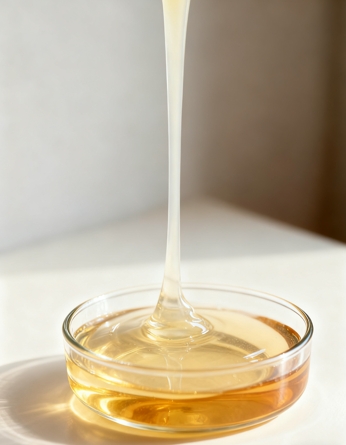 |
The result of this fusion is a non-ionic, liquid emollient with a unique combination of spreading, solubilizing, and sensory properties that neither of its parent materials possesses on its own.
Key Properties and Functional Advantages: The Source of Its Performance
- Exceptionally Dry and Silky Skin Feel:
This is its most celebrated attribute. Unlike many oils and esters that can leave a greasy or oily residue, Castoryl Maleate imparts a remarkably dry, powdery, and silkyafter-feel. This makes it ideal for formulations where a non-greasy finish is paramount, such as facial serums, day creams, and sunscreens. - Excellent Spreading and Wetting Agent:
The molecule's structure allows it to spread rapidly and evenly over the skin and hair. This property helps to create a uniform film, ensuring other ingredients in the formulation are distributed evenly. It also acts as an effective wetting agent for pigments, making it valuable in color cosmetics. - Enhanced Solubilizing Power:
Castoryl Maleate is an excellent solvent for a range of Oil-soluble active ingredients and UV filters. It can help dissolve and stabilize crystalline materials, preventing them from recrystallizing in the final product and ensuring formula homogeneity and efficacy. - Improved Gloss and Lubricity:
When used in hair care products, it provides a high level of lubricity, reducing combing force and adding significant shine without weighing hair down or making it feel heavy or greasy. - Good Oxidative Stability:
Due to its hydrogenated base and synthetic structure, it exhibits good stability against rancidity, contributing to a longer shelf life for the products that contain it.
Applications in Cosmetics and Personal Care
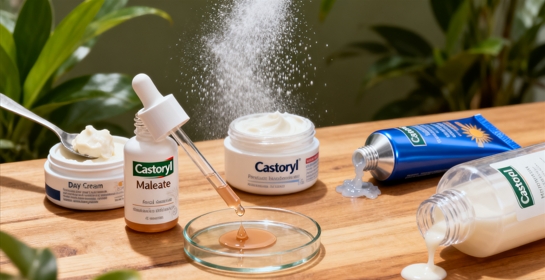
- Facial Serums and Oils: Used as a base oil to create "dry-touch" serums that absorb quickly and leave a velvety, non-greasy finish. This is perfect for oil-based Vitamin C or Retinol serums targeted at consumers who dislike a heavy feel.
- Day Creams and Moisturizers: Imparts a smooth, silky texture that is ideal under makeup. It reduces the tackiness that can sometimes occur with certain humectants or emulsifiers.
- Sunscreens: Its ability to solubilize organic UV filters and provide a dry, non-greasy feel makes it a top choice for high-SPF facial sunscreens that need to be cosmetically elegant.
- After-Sun and Lightweight Body Lotions: Provides emolliency without the heavy, sticky feeling that is undesirable in warm weather or on large body surfaces.
Hair Care:
- Leave-in Conditioners and Serums: Delivers high shine and superb detangling without silicone-like buildup. It smooths the hair cuticle, fighting frizz and imparting a sleek, polished look.
- Hair Oils: Can be used in non-greasy hair oil formulations that provide manageability and shine without making hair look oily.
Color Cosmetics:
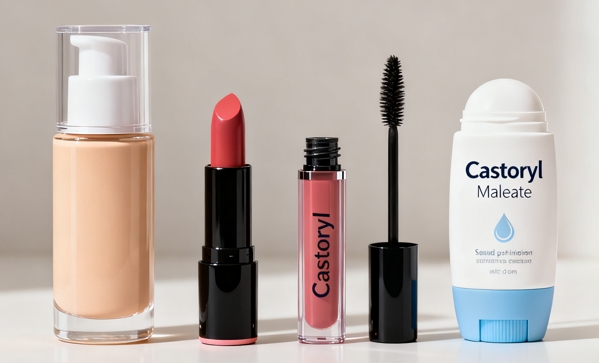
- Liquid Foundations: Its wetting agent properties help disperse pigments evenly, contributing to smooth application and blendability.
- Lipsticks and Lip Glosses: Provides a smooth, non-sticky glide and contributes to a glossy finish.
- Mascara: Helps to suspend pigments and create a smooth film on lashes.
Deodorants and Antiperspirants:
Its dry skin feel and spreading characteristics make it an excellent emollient for stick and roll-on formulations, improving application comfort and reducing white residue.
The Science Behind the Sensory Feel
The "dry" skin feel of Castoryl Maleate has a physicochemical basis:
- High Polarity: The maleate group in its molecule increases its polarity.
- Ultra-Thin Film: This polarity allows it to interact strongly with the skin and spread into a uniform, thin layer.
- Eliminates Greasiness: This thin film avoids the heavy, occlusive feeling that the brain interprets as "greasy."
- Final Sensation: The result is smooth, soft skin, perceived as "dry" and "silky."
While specific studies on Castoryl Maleate itself are often proprietary to manufacturers, the broader science of ester functionality in cosmetics is well-established. Textbooks like Harry's Cosmetology and resources from the Society of Cosmetic Chemists detail how the molecular structure of esters directly influences their spreading coefficient, polarity, and ultimately, the sensory properties they impart.
Safety and Regulatory Status
Castoryl Maleate is considered a safe and well-tolerated cosmetic ingredient. It is not known to be a primary irritant or sensitizer. As with all cosmetic ingredients, it should be used in compliance with good manufacturing practices. It is compliant for use in cosmetics in major markets including the European Union, the United States, and Asia.
Conclusion: The Signature of a Premium Formulation
Castoryl Maleate is more than just an emollient; it is a tool for crafting a specific, high-end user experience. In a market where sensory appeal can be the deciding factor for a consumer, its ability to deliver a luxurious, dry, and silky skin feel provides a significant competitive advantage.